
02 Nov Does Speech Delay Always Mean Autism? Signs, And Differences
When a child doesn’t start speaking on time, parents naturally become worried.
One of the biggest concerns is whether it’s speech delay in children or autism.
Although speech delay and autism can both affect communication, they are different conditions.
Does speech delay always mean autism? No. Some children have delayed speech without autism.
Others may have autism speech delay along with social and behavioural differences.
It’s so helpful for parents to know the difference between speech delay vs autism—it leads to an early evaluation and the right mental health support for their child.
What Is Speech Delay?
Speech delay is when a child isn’t developing speech and language skills in the way expected for their age.
Naturally, children do not all grow at the exact same pace, but there are typical speech milestones by age that act as a rough guide.
If these milestones are delayed, it may indicate speech delay in children.
Common Speech Milestones By Age
- 6–9 months: Babbling begins.
- 12–15 months: Says simple words such as “mama” or “papa.”
- 18 months: Uses around 10–20 meaningful words.
- 2 years: Starts using two-word phrases.
There are a few forms of speech delay.
Some children show expressive language delay, meaning they might understand words yet struggle when it’s time to say them.
Others show receptive language delay, where understanding also becomes difficult. In some cases, both areas are affected.
Language delay in children may affect understanding, speaking, or both.
Speech delay in children can happen for multiple reasons.
It could relate to hearing concerns, developmental delay in children, or other underlying conditions.
Even with speech delay symptoms, many children continue to communicate through gestures, facial expressions, or playful sounds.
They often remain socially engaged with family members and other children.
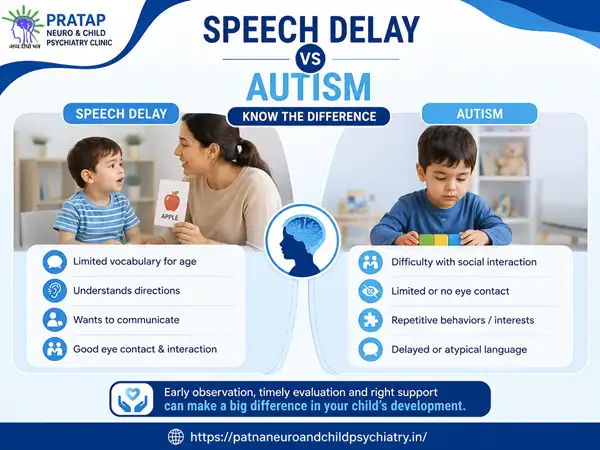
Speech Delay Vs Autism: Key Differences
Getting a clear picture of speech delay vs autism becomes easier when you look at overall development, not just speech.
While speech delay and autism can both affect communication, there are several important differences.
1. Communication Skills
Children with speech delay often try to communicate through gestures, facial expressions, or sounds.
Autistic children may have difficulties with both verbal and non-verbal communication.
2. Eye Contact
Children with speech delay usually maintain eye contact during interactions.
They may avoid or have limited eye contact if autism is present.
3. Social Interaction
Children experiencing speech delay generally enjoy playing and interacting with others.
Those with autism may show less interest in social interaction or find it difficult to engage with peers.
4. Response To Name
Most children with speech delay respond when their name is called.
Children on the autism spectrum may respond inconsistently, even when their hearing is normal.
5. Use Of Gestures
Pointing, waving, and showing objects are common in children with speech delay.
These gestures may be limited or used inconsistently in autism.
6. Pretend Play
Children with speech delay usually enjoy pretend play.
In autism, pretend play may be limited or repetitive.
7. Repetitive Behaviours
Repetitive behaviours are uncommon in speech delay.
They are more common in children with autism and may include hand flapping, rocking, or lining up toys.
8. Restricted Interests
Restricted interests are not usually linked to speech delay.
Autism may involve intense interest in specific objects or activities.
9. Language Development
Children with speech delay mainly struggle with speaking but continue developing social communication.
Those with autism may also have difficulties with social communication and behaviour.
10. Emotional Expression
Children with speech delay usually express emotions naturally.
Children with autism spectrum disorder may express emotions differently or have difficulty showing them in social situations.
11. Following Simple Instructions
Most children with speech delay can follow simple instructions.
Some autistic children may find this difficult, especially when social understanding is involved.
12. Overall Developmental Pattern
Speech delay mainly affects language development.
Autism affects communication, social interaction, behaviour, and other areas of development.
Signs That Speech Delay May Be Linked To Autism
Speech delay alone does not always mean autism.
However, if delayed speech appears along with other behavioural and social differences, it may be one of the early signs of autism.
These autism symptoms in children often go beyond communication and affect how a child interacts with others and responds to their surroundings.
- Limited eye contact: A child may avoid eye contact or find it difficult to maintain during interactions.
- Poor response to name: Not responding consistently when called can be one of the signs of autism in toddlers, even when hearing is normal.
- Limited use of gestures: Rarely pointing, waving, or showing objects to communicate may indicate social communication difficulties.
- Difficulty with imitation: Not copying sounds, facial expressions, or simple actions may suggest developmental differences.
- Repetitive behaviours: Hand flapping, spinning objects, or lining up toys are common behaviours associated with autism.
- Restricted interests: Showing intense interest in specific objects or activities for long periods.
- Sensory sensitivities: Being unusually sensitive to sounds, lights, textures, or certain smells.
- Difficulty with social interaction: Limited interest in playing with others or sharing enjoyment with family members.
If speech delay and autism are suspected together, an early autism assessment for children can help identify the cause and ensure the right support starts as soon as possible.
Other Possible Causes Of Speech Delay
Speech delay in children can happen for many reasons.
Delayed speech in toddlers is also common, and autism is only one possible cause.
Looking at other child speech delay causes helps reduce unnecessary worry and ensures children receive the right evaluation and treatment.
- Hearing problems: If a child cannot hear sounds clearly, speech and language development may be affected.
- Developmental Language Disorder (DLD): Some children have difficulty understanding or expressing language without having autism or other developmental conditions.
- Oral-motor difficulties: Problems with the muscles used for speech can make it difficult to produce clear words.
- Intellectual disability: Delays in overall development may also affect speech and language skills.
- Premature birth: Babies born early may take longer to reach communication and other developmental milestones.
- Limited language exposure: Children learn language through regular conversations and interaction. Limited exposure may contribute to delayed speech development.
Finding out why a child has a speech delay is important because each child needs a special plan.
A proper evaluation helps determine the reason behind the delay and the most appropriate treatment.
When Should Parents Seek An Evaluation?
It can be difficult to decide whether to wait or seek help. Many parents also wonder when to worry about speech delay.
Although every child develops at their own pace, certain speech delay symptoms should not be ignored.
- If a child is not babbling by 12 months, it may be a sign of delayed language development.
- By 16 months, most children use a few meaningful words. If that is not happening, it is a good idea to consult a specialist.
- By 24 months, most children start using two-word phrases such as “want water” or “go outside.”
- If your child is not talking at 2 years or is not combining words, a professional evaluation is recommended.
Any loss of speech or social skills at any age also needs immediate medical attention.
Parents should also watch for early signs of autism, such as limited eye contact, poor response to name, or reduced social interaction.
These signs do not confirm autism, but they should not be ignored.
Seeking an autism assessment for children or evaluation for speech delay in children at the right time can identify the cause early and help children receive appropriate support without unnecessary delays.
How Is Autism Diagnosed In Children?
Autism diagnosis in children involves a detailed developmental evaluation.
There is no single medical test to confirm autism.
Specialists use observations, structured assessments, and information shared by parents to reach a diagnosis.
The evaluation usually begins with a developmental history.
Parents are asked about speech milestones, social interaction, daily behaviour, and other developmental concerns.
This helps specialists understand the child’s overall growth and identify possible autism symptoms in children.
A behavioural assessment is then performed. Specialists observe eye contact, communication, gestures, play skills, and responses to social situations.
A professional may also recommend a speech and language evaluation to assess both expressive and receptive language skills.
They often include a hearing test because hearing problems can also affect speech development.
If specialists suspect autism, they may recommend an autism assessment for children using standardised diagnostic tools.
An early and accurate autism diagnosis in children helps families access appropriate therapies, educational support, and early intervention.
Treatment Options For Speech Delay And Autism
Treatment for speech delay and autism depends on the child’s diagnosis, age, and individual needs.
Early intervention can improve communication, social skills, and overall development.
The right treatment plan is based on a professional evaluation.
Speech delay treatment usually includes speech therapy, parent involvement, and regular communication practice at home.
Speech Therapy
Speech therapy for children is the primary treatment for speech delay in children.
A speech-language therapist helps children improve communication through play, structured activities, and daily routines.
Parent involvement is equally important.
Talking, reading, and encouraging communication at home give children more opportunities to develop speech and language skills.
Autism
Children diagnosed with autism often need a combination of therapies.
Along with speech therapy, behaviour therapy helps improve social communication and manage challenging behaviours.
Occupational therapy supports sensory processing and daily living skills.
Parent training is also an important part of autism treatment.
It helps families support their child’s development at home.
Every child benefits from an individualised treatment plan based on their strengths and challenges.
Consistent therapy and early intervention can lead to meaningful progress over time.
When To Consult A Child Psychiatrist
If your child has speech delay along with social, behavioural, or developmental concerns, it is a good idea to consult a child psychiatrist.
An early evaluation can identify the underlying cause and recommend the most appropriate treatment.
If you are looking for a child psychiatrist in Patna or an autism specialist in Patna, Dr. Vivek Pratap Singh provides comprehensive developmental assessments for children with speech delay, autism, ADHD, and other behavioural concerns.
When needed, he may also recommend an autism assessment for children to ensure an accurate diagnosis.
Early consultation allows treatment to begin at the right time.
It also helps children receive appropriate therapies and support based on their individual needs.
If doctors have diagnosed your child with autism, timely autism treatment in Patna can improve communication, social skills, and overall development.
Families looking for speech delay treatment in Patna can benefit from an early evaluation and an individualised treatment plan.
Conclusion
Speech delay and autism can sometimes appear similar, but they are not the same condition.
While speech delay mainly affects communication, autism also involves differences in social interaction and behaviour.
Paying attention to the overall pattern of development is more helpful than focusing on speech alone.
If you notice speech delay symptoms or other developmental concerns, seek a professional evaluation without unnecessary delay.
Early diagnosis and the right support can make a meaningful difference in your child’s progress.
FAQs
1. Can a child have normal speech and still have autism?
Yes. Some children with autism develop normal or even advanced language skills.
However, they may still have difficulties with social communication, eye contact, or understanding conversations.
2. Does bilingual exposure cause speech delay?
No. Learning two languages does not cause speech delay in children.
Some bilingual children may mix languages at first, but this is a normal part of language development.
3. Can hearing problems be mistaken for autism?
Yes. Hearing loss can sometimes cause delayed speech and reduced responses, which may resemble autism.
A hearing test is an important part of an autism assessment for children.
4. Is speech delay more common in boys?
Yes. People report speech delay in children more often in boys than girls.
However, every child develops differently, so we always recommend an individual assessment.
5. At what age should speech therapy begin?
Speech therapy for children can begin as early as 18 months if developmental delays are identified.
Early intervention often leads to better communication outcomes.
6. Can a late talker catch up without therapy?
Some late talkers improve without treatment.
However, if speech delay continues or a professional evaluates it along with social or behavioral concerns, they recommend further assessment.
7. Which doctor should parents consult first for speech delay?
Parents can first consult a paediatrician or a speech-language therapist.
If there are additional developmental or behavioural concerns, a child psychiatrist in Patna or a developmental specialist can recommend further evaluation and treatment.
8. Is Speech Delay the Same As Late Talking?
No. Speech delay vs late talking is an important difference.
Some late talkers catch up naturally, while speech delay may need professional evaluation and therapy.
No Comments