
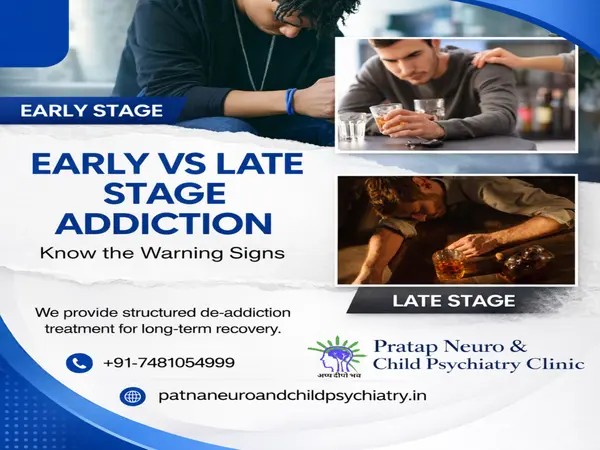
20 Apr Early Stage vs Last Stage Addiction: Warning Signs & When to Seek Help
Addiction develops gradually over time.
It often begins with normal or occasional use, but can slowly turn into full dependence that affects every part of a person’s daily life.
In many cases, this shift is not noticed until the condition has already become serious.
The early stage and the last stage of addiction show clear differences in patterns, behavior, and impact.
Paying attention to these changes can help identify when the situation is moving in a harmful direction and when action is needed.
Addressing addiction at an early stage makes treatment simpler and more effective.
Timely support and the right approach, including professional de-addiction treatment, can prevent the condition from progressing further and reduce long-term consequences for both the individual and their family.
The difference between early stage vs last stage addiction becomes important when identifying how the condition progresses.
What is Addiction?
Addiction is an intricate condition which causes individuals to develop dependence on substances such as alcohol or drugs, or certain behaviors, even when these things lead to negative consequences.
It is both a medical and psychological condition that affects a person’s ability to control their actions.
In simple terms, addiction develops when repeated use turns into a habit that the body and mind start relying on.
The alcohol addiction definition includes a pattern where a person feels the need to drink regularly and finds it difficult to stop despite its impact on health, relationships, and daily life.
Addiction does not develop instantly.
It progresses through different addiction stages, where occasional use gradually shifts toward dependence.
As this progression continues, the need for the substance becomes stronger, while control over its use becomes weaker.
Effects Of Addiction On Brain and Behavior
Addiction produces strong effects on both brain function and behavior.
When a person uses substances like alcohol or drugs, the brain releases dopamine, a chemical responsible for pleasure and reward.
With repeated use, the brain begins to depend on this stimulation.
Over time, natural dopamine production decreases, and everyday activities no longer provide the same level of satisfaction.
This leads to increased use of the substance to feel normal, which is a key pattern seen across different addiction stages.
Addiction also affects the part of the brain responsible for decision-making and impulse control.
As this function weakens, it becomes difficult to make balanced decisions or resist cravings.
These changes are reflected in behavior.
A person may start neglecting responsibilities, withdrawing from social life, or experiencing mood swings, irritability, anxiety, or depression.
The urge to use the substance becomes stronger, even when the harmful effects are clearly visible.
With the right addiction recovery treatment, these patterns can be managed, and individuals can gradually regain control over their behavior and daily life.
What is Early Stage Addiction?
The first stage of addiction begins when people start using substances more frequently to achieve certain effects or cope with situations.
At this point, there is still a sense of control, but gradual internal changes begin to take place.
This phase is often referred to as early stage addiction or the initial stage of drug addiction, where patterns start forming without clear warning.
Key Characteristics
- Use often begins in social settings or specific situations such as parties or periods of stress. Over time, frequency may increase beyond occasional use.
- Tolerance starts to develop, meaning the same amount no longer produces the desired effect, leading to higher consumption.
- Substances may be used as a way to deal with emotional discomfort, stress, or personal challenges.
- Mild behavioral changes may appear, such as irritability, reduced focus, or a slight withdrawal from responsibilities.
Common Signs
- Early signs of addiction can be subtle and are often ignored at this stage.
- Cravings may begin to appear, and thoughts about the substance become more frequent.
- There may be noticeable mood changes, including irritability or emotional fluctuations.
- Daily responsibilities, tasks, or commitments may start getting neglected.
- Denial is common—many individuals believe they are still in control and can stop anytime.
These early addiction symptoms may not seem serious at first, but they indicate a shift toward dependency.
Paying attention at this stage can prevent further progression and make treatment more manageable.
What is Last Stage Addiction?
The term last stage addiction refers to a severe level of dependence where both the body and mind rely completely on the substance.
At this point, use is no longer a choice—it becomes a need to function in daily life.
This stage is also known as late stage addiction, where the impact is visible across health, behavior, and relationships.
Key Characteristics
- There is complete physical and psychological dependence on the substance.
- The body requires the substance to carry out normal daily functions.
- Use becomes persistent and difficult to control, even when the person tries to stop.
- Long-term use leads to serious physical and mental health problems.
Common Signs
- The signs of addiction are more intense and difficult to ignore at this stage.
- Withdrawal symptoms appear when the substance is not used. These may include shaking, sweating, anxiety, or nausea.
- There is a clear decline in work performance, relationships, and the ability to manage daily responsibilities.
- The person may withdraw from family and friends or hide their behavior.
- Risky actions, such as driving under the influence or engaging in illegal activities, may occur.
These addiction symptoms show how deeply the condition has affected daily life.
At this stage, professional treatment and structured support become necessary to manage the condition and begin recovery.
To better understand early stage vs last stage addiction, it helps to compare how control, behavior, and impact change over time.
Early Stage vs Last Stage Addiction
When comparing early stage vs last stage addiction, the differences become more visible in daily patterns and dependence.
Here’s a practical comparison of early-stage vs last-stage addiction (sometimes called late-stage).
Level of Control:
In the early stage, individuals often feel they are in control and believe they can stop whenever they want.
However, in the last stage, this control is lost, and substance use becomes compulsive.
Frequency of Use:
Early stage use is usually occasional or limited to certain situations, such as social events or stressful moments.
On the other hand, in the last stage, use becomes frequent and may continue throughout the day.
Physical Dependence:
There is little to no physical dependence in the early stage.
Nonetheless, in the last stage, the body relies on the substance to function normally.
Tolerance and Withdrawal:
During the early stage, tolerance may begin to build, but withdrawal symptoms are mild or not clearly noticeable.
That said, in the last stage, tolerance is high, and withdrawal symptoms become strong and difficult to manage.
Behavioral Changes:
Early stage changes are subtle, such as mood swings or slight neglect of responsibilities.
In the last stage, behavior shifts significantly, often involving isolation, secrecy, and risky actions.
Impact on Life:
The early stage may not appear to disrupt daily life in a major way.
Though, in the last stage, addiction affects health, relationships, work, and overall well-being in a serious way.
How Addiction Progresses?
Addiction usually progresses through a few common stages of addiction, but the timeline and pattern vary by substance, person, and environment.
A helpful way to think about it is: reward → habit → compulsion → loss of control, with increasing harm.
The pattern explained in early stage vs last stage addiction shows how gradual changes lead to deeper dependence.
Gradual transition from voluntary use to dependence
The process of becoming dependent on a substance often begins with voluntary use.
A person may start using drugs occasionally, such as during social situations or times of stress.
At this stage, it usually feels controlled, and the person may believe it only provides temporary relief or benefits.
With repeated use, patterns begin to change. The frequency of use may increase, sometimes even without a clear reason.
Over time, substance use becomes a way to relax or cope with emotions, rather than a choice made occasionally.
What starts as controlled use gradually turns into a habit.
As this pattern continues, the body and mind begin to rely on the substance.
The person may reach a point where daily functioning feels difficult without it.
This transition from casual use to dependence happens step by step, often making it hard to notice when the situation has become serious.
Role of Tolerance and Withdrawal
Addiction progression is closely linked to tolerance and withdrawal.
As the body adapts to a substance, its effects begin to weaken, leading to the need for higher amounts to achieve the same result.
With increased tolerance, usage becomes more frequent and more intense.
When a person tries to reduce or stop, withdrawal symptoms may appear. These can include anxiety, restlessness, sweating, or physical discomfort.
To avoid these symptoms, the person may continue using the substance, creating a cycle where tolerance increases and withdrawal becomes harder to manage.
This cycle plays a major role in deepening dependence.
Psychological and Environmental Triggers
Psychological and environmental factors strongly influence how addiction develops and continues.
Emotional stress, trauma, loneliness, or existing mental health concerns can lead a person to rely on substances as a way to cope.
Environmental triggers also play a role. Certain places, people, or situations linked to past use can create strong urges.
Being around others who use substances or visiting familiar environments can increase the chances of repeated use.
These triggers make it more difficult to break the pattern and may lead to continued use or relapse, which further strengthens the cycle of addiction.
Risks of Ignoring Early Stage Addiction
Ignoring early-stage addiction can be risky because it often doesn’t stay “early.”
In many people, it escalates gradually from occasional use to a stronger habit, then to loss of control.
Faster progression to severe addiction
When early signs are ignored, addiction can progress more quickly.
What may seem manageable in the beginning can turn into a pattern that becomes difficult to control.
Over time, the person may start using larger amounts to achieve the same effect, which increases the risk of dependence.
As this continues, stopping becomes more challenging and may require structured treatment.
Mental health issues (anxiety, depression)
Substance use can have a direct impact on mental health.
Ignoring early stage addiction increases the risk of conditions such as anxiety and depression.
What may begin as a way to cope with stress can gradually worsen emotional well-being.
Changes in brain chemistry can lead to mood instability, irritability, and a sense of low motivation.
Instead of relieving stress, substance use often adds to emotional difficulties over time.
Impact on family, career, and social life
Addiction does not affect just one area of life—it gradually impacts relationships, work, and social connections.
In the early stage, these effects may seem minor, but they can grow if the pattern continues.
Relationships with family and friends may become strained due to changes in behavior, reduced trust, or emotional distance.
At work, productivity may decline, and responsibilities may be neglected.
Social life may also be affected, as interest in meaningful interactions decreases.
If left unaddressed, these changes can lead to isolation, financial stress, and a lower quality of life.
When To Seek Help For Addiction?
Seeking help becomes important when substance use starts affecting daily life, health, or relationships.
One of the early signs is a growing urge to use, along with difficulty in limiting or controlling intake.
If the same amount no longer feels enough and there is a need to increase usage, it may indicate that the pattern is becoming stronger.
Changes in mood, behavior, or the ability to handle responsibilities are also signs that should not be ignored.
Help is especially important if stopping or reducing use leads to discomfort or withdrawal symptoms, or if use continues despite clear negative effects.
If your substance use is starting to affect your daily routine, health, or relationships, it’s okay to ask for help.
Knowing the difference between early stage vs last stage addiction can help decide when it’s time to seek support.
Connecting with a reliable de-addiction center in Patna can give you the professional support and guidance you need to start healing.
Getting support at the right time can make the recovery process more manageable and prevent the condition from becoming more severe.
Treatment Options for Different Stages
Addiction treatment options generally match the stage of addiction, because what people need changes as dependence, withdrawal risk, and life disruption increase.
Below is a practical “stage-by-stage” map (works for many substances, with substance-specific differences noted).
1) Early Stage
Counseling & therapy
Counseling and therapy are most effective in the early stage, as they can help stop the condition from progressing further.
At this point, there is still some level of control, which makes it easier to address the issue.
Therapy focuses on the underlying reasons behind substance use, such as stress, emotional challenges, or social pressure.
Approaches like cognitive behavioral therapy (CBT) help in changing harmful patterns and building healthier ways to cope.
Lifestyle changes
Making changes to daily habits plays an important role in early recovery.
A structured routine, proper sleep, and a balanced diet support both physical and mental health.
Regular exercise can improve mood and reduce the urge to rely on substances.
Activities like meditation, yoga, or hobbies can provide healthier ways to manage stress.
These changes help replace harmful patterns with more stable and positive habits.
Family support
Support from family can make a significant difference in the early stage.
A safe and supportive environment encourages open communication and reduces feelings of isolation.
Family members can help by offering emotional support, encouraging positive behavior, and staying involved in the recovery process.
This kind of support often improves motivation and consistency in treatment.
2) Last Stage
Medical detox
In the last stage, medical detox is often the first step.
At this point, the body has developed strong dependence, and stopping suddenly can lead to serious withdrawal symptoms.
Detox under medical supervision helps manage these symptoms safely and reduces complications.
It prepares the individual for the next stage of treatment.
Rehabilitation programs
Rehabilitation programs provide structured care for individuals dealing with severe addiction.
Inpatient programs offer a controlled environment where focus remains on recovery without outside triggers.
Outpatient programs allow individuals to continue daily activities while receiving treatment.
These programs usually include therapy, group sessions, and skill-building to support long-term change.
Long-term therapy and relapse prevention
Recovery does not end after detox or rehabilitation.
Ongoing therapy helps maintain progress and prevent relapse. It focuses on managing triggers, handling cravings, and building healthier coping strategies.
Support groups and regular follow-ups can help maintain consistency and provide guidance during challenging phases.
Long-term support increases the chances of sustained recovery.
Small patterns can turn into serious challenges over time—seeking the right de-addiction treatment in Patna at the right stage can help regain control before things get worse.
Addiction Prevention Tips
Here are practical addiction prevention tips that help reduce risk early (and keep it from escalating).
They’re relevant for alcohol, nicotine, drugs, gaming, and other compulsive behaviors.
Awareness and education
Awareness plays a key role in preventing addiction.
When people are informed about the risks and long-term effects of substance use, they are more likely to make safer choices.
Education in schools, workplaces, and communities can help highlight early warning signs and encourage timely action.
Healthy coping mechanisms
Developing healthy ways to manage stress and emotions can reduce the risk of substance use.
Activities such as exercise, meditation, journaling, or engaging in hobbies can provide positive outlets.
These habits support emotional balance and reduce dependence on harmful coping methods.
Avoiding triggers and peer pressure
Certain people, places, or situations may increase the urge to use substances.
Being aware of these triggers can help in avoiding risky situations.
Learning to say no and setting clear boundaries can reduce the impact of peer pressure.
Surrounding oneself with supportive and positive influences can also help in maintaining healthier habits.
Conclusion
Addiction often begins with small, unnoticed changes but can gradually turn into a serious condition that affects every part of life.
The difference between early stage and last stage addiction lies in the level of control, dependence, and overall impact on health and daily functioning.
In the early stage, there is still an opportunity to take action and prevent further progression.
On the other hand, in the last stage, structured treatment and consistent support become necessary for recovery.
Nonethless, in both cases, timely intervention plays an important role in improving outcomes.
Taking the first step toward help can make a meaningful difference.
With the right support and approach, it is possible to regain control and move toward a healthier and more stable life.
When substance use starts affecting daily life, consulting an experienced de-addiction specialist can make a meaningful difference in the recovery process.
FAQs
1. What does last stage addiction look like?
Last stage addiction involves strong physical and psychological dependence.
A person may need the substance to function normally and may experience withdrawal symptoms without it.
Daily life, relationships, and health are often significantly affected.
2. What is late stage addiction?
Late stage addiction refers to a severe level of dependence where substance use becomes compulsive.
At this stage, stopping without professional help is difficult due to both physical and mental reliance on the substance.
3. What is the final stage of alcohol addiction?
The final stage of alcohol addiction is often called end-stage alcoholism.
It can lead to serious health problems such as liver damage, cognitive decline, and increased risk of life-threatening complications.
4. Which stage of addiction is hardest to treat?
The later stages are generally more challenging because of strong dependence and withdrawal symptoms.
However, with proper treatment and support, recovery is still possible at any stage.
5. How do I know if addiction has become severe?
Addiction may be severe if there is loss of control over use, strong withdrawal symptoms, continued use despite harm, and major disruption in daily life.
In such cases, seeking professional help is important.
No Comments